
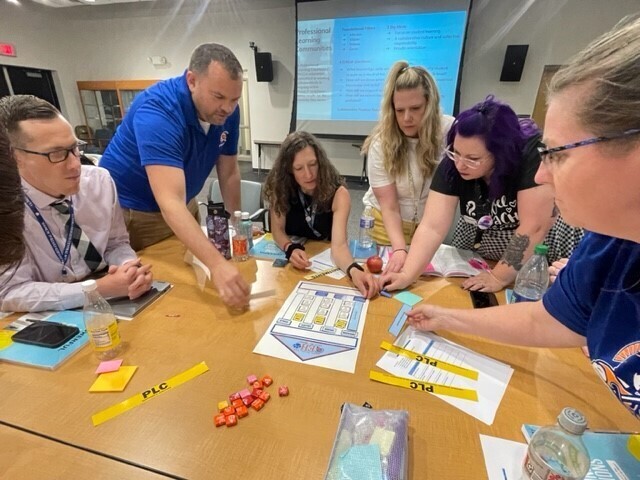
 Our first half day is September 30
As we enter our fourth year on our Professional Learning Community (PLC) journey, we are taking an important next step together. This year’s theme is simple:
Nail Our Work.
Throughout the school year, our teams of teachers will use scheduled half days to work collaboratively on the systems that have the greatest impact on student learning. While a half-day schedule creates some logistical challenges for families, these days are an important investment in the work happening behind the scenes to make students’ everyday classroom experiences stronger.
Our teachers will be working together to fine-tune, update, and calibrate curriculum, instruction, and assessment. Teams will continue their curricular overhauls by identifying essential standards, developing meaningful formative assessments, establishing common expectations, and creating data protocols that help teachers determine what students know, what they still need, and what we should do next.
This is the heart of our PLC work: teachers working together to ensure that every student has access to high-quality instruction and receives the right support or extension at the right time.
Strengthening RTI and MTSS
A major focus of this work is strengthening our Response to Instruction (RTI) system within a broader Multi-Tiered System of Supports (MTSS) framework.
Depending on the building, students may experience additional instructional support or extension through Tier 2, Tier 3, Advisory, or WIN time. At the same time, our schools are continuing to structure and enhance the systems we use to support students' social-emotional and behavioral needs.
MTSS provides a framework for organizing these supports across multiple levels. It emphasizes strong universal, or Tier 1, practices for all students, along with increasingly targeted supports for students who need additional assistance. Teams use data and ongoing progress monitoring to identify needs, provide appropriate interventions, and adjust supports over time.
Our goal is to build a system in which we respond to the whole student—academically, socially, emotionally, and behaviorally.
The U.S. Department of Education's What Works Clearinghouse describes RTI as a framework that includes screening, differentiated instruction, targeted intervention, and ongoing progress monitoring. Research and federal guidance around MTSS similarly emphasize using data to provide increasingly targeted supports based on individual student needs.
This work begins with strong Tier 1 instruction and universal supports. When teachers have clarity about essential standards, common expectations, effective instructional practices, and meaningful ways to check student understanding—and when schools have strong universal social-emotional and behavioral supports—we are better positioned to respond to what students actually need.
Why formative assessment matters
Our PLC teams will also be strengthening formative assessment—the ongoing process of gathering evidence of student understanding during learning so teachers and students can make informed next steps.
Recent research supports the value of this work. A 2024 meta-analysis examining 118 studies and 258 effect sizes found a positive overall relationship between formative assessment and K–12 academic achievement, while also noting that the impact varies by implementation and context.
In other words, the assessment itself isn't the destination. What teachers do with the information is what matters.
That is why our teams are working to create common formative assessments and data protocols that allow us to ask meaningful questions:
What are students expected to learn?
How will we know if they have learned it?
What will we do when students haven't learned it yet?
What will we do when students already demonstrate mastery?
What additional academic, social-emotional, or behavioral support might a student need?
How will we know whether our response made a difference?
Collaboration with a purpose
Research on professional learning communities and professional communities has examined the connection between teacher collaboration and student achievement, although researchers also caution that PLCs vary considerably in structure, implementation, and effectiveness.
That distinction matters to us.
Simply meeting is not a PLC.
Our goal is to make our collaborative time purposeful—focused on curriculum, instruction, assessment, evidence of student learning, student well-being, and the instructional and support responses that follow.
Our teachers are doing this work because students deserve a coherent, responsive, and supportive school experience, regardless of which classroom or building they enter.
So, yes, there will be some days when students leave school earlier than usual.
But behind that shortened student schedule is a full day of professional work dedicated to answering one essential question:
How can we get better at helping every student learn, grow, and reach new heights?
On September 30, we begin our first half day of the year.
We are ready to Nail Our Work.